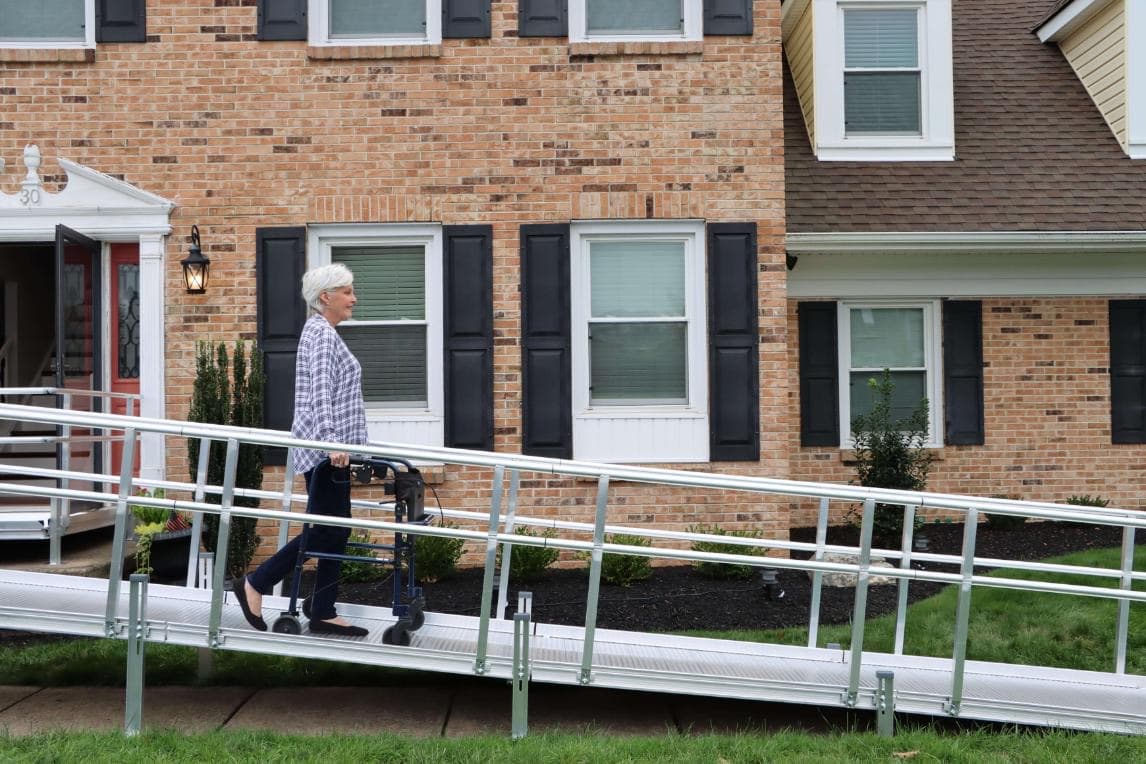
Sometimes the conversation starts with a bathtub. A parent hesitates before stepping over the side. A walker catches in a narrow doorway. Someone who has always managed independently begins waiting for help with a routine that used to feel private and simple.
Soon, the family is asking a much bigger question: can this home still work?
For some households in Dallas, Fort Worth, and surrounding communities, thoughtfully chosen home modifications and a sustainable care plan can make remaining at home more manageable and less expensive than assisted living. For others, the level of support needed makes a community the better choice. The answer depends on the person, the property, and the complete cost of care.
The local benchmark is $6,000 per month. That is the 2025 median assisted-living rate for the Dallas–Fort Worth–Arlington region in CareScout’s Cost of Care Survey. This guide uses that benchmark to explore what a $15,000, $25,000, or $50,000 home investment might mean over five, seven, or ten years. The examples are planning scenarios, not promises that a remodel will prevent a move.
Quick answer
Staying home with modifications can cost less than assisted living when the total monthly cost of living and care at home stays below the cost of a suitable community, and the home stays usable long enough to pay back the remodel. In the DFW example below, a $25,000 project with a $2,000 monthly difference is offset in about 12.5 months. With 30 hours of paid care a week, though, staying home costs more than the $6,000 assisted-living benchmark before any remodeling. Use the calculator to run the numbers for your city.
What does assisted living cost in Dallas and Fort Worth
CareScout’s 2025 survey reports a median of $6,000 monthly, or $72,000 annually, for assisted living in the Dallas area, identified in its data as Dallas–Fort Worth–Arlington. The survey’s assisted-living measure is a private, one-bedroom arrangement. A median is a middle value across reported prices, so individual communities can be substantially above or below it.
Holding that monthly rate constant gives the following planning totals:
Assisted-living spending at a constant $6,000 per month
| Time in assisted living | Total spending |
|---|---|
| 1 year | $72,000 |
| 5 years | $360,000 |
| 7 years | $504,000 |
| 10 years | $720,000 |
These are gross assisted-living costs before future increases or additional charges. They are not the amount a homeowner automatically saves by staying home. Assisted living includes housing and services; living at home also has continuing expenses.
Ask each community for a written estimate covering the apartment, required care level, medication assistance, meals, one-time fees, and likely additional charges. Confirm how prices change when support needs increase. A monthly advertising rate may describe a different service package from the one your family needs.
Why this guide compares assisted living rather than senior living generally
“Senior living” can refer to independent living, assisted living, memory care, or a campus offering several levels of support. Combining those prices makes the comparison less useful. This article uses assisted living as its benchmark; it does not treat a bathroom renovation as a substitute for medical care or supervision.
What should a home modification budget include
The right project starts with the task that has become difficult. Stepping over a tub may call for a different solution than turning a wheelchair, transferring to a toilet, or making room for a caregiver.
EverSafe’s published 2026 tub-to-shower conversion cost guide lists project pricing for Dallas, Fort Worth, and the DFW area from $11,900 to $22,500, depending on the selected scope and package. That is EverSafe’s published range for this service, not a market-wide average or a quote for your bathroom.
The $15,000, $25,000, and $50,000 budgets used below are hypothetical investment amounts. A larger budget may be appropriate when work extends beyond the shower into doorways, flooring, fixtures, lighting, or entry access. Structural repairs, plumbing changes, permits, and site conditions can change the price. Start with a written scope and a property-specific assessment.
Plan around the whole daily routine
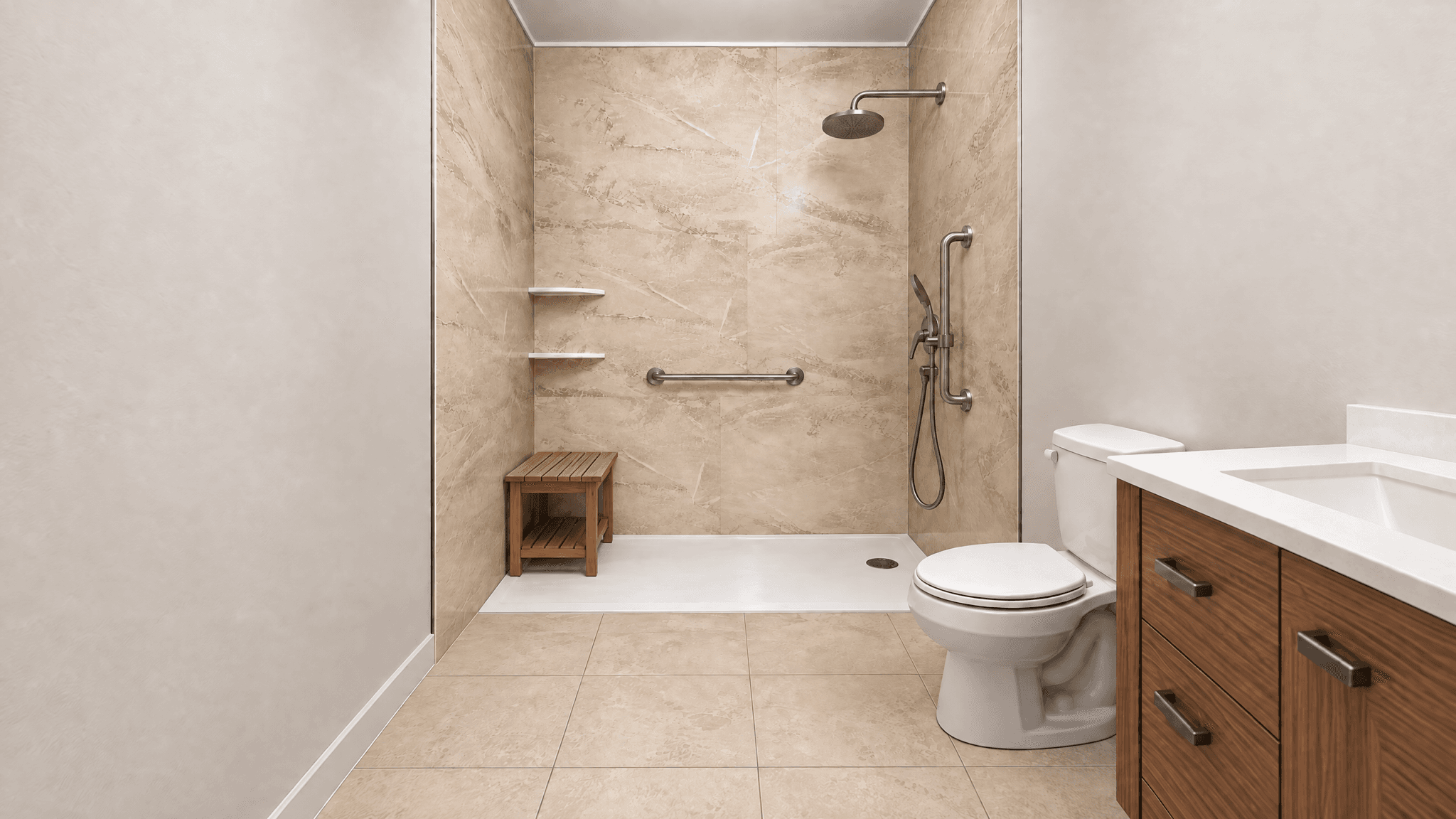
Potential improvements include a barrier-free shower; securely installed grab bars inside and outside the shower; seating and a handheld showerhead; an appropriately selected comfort-height toilet; slip-resistant flooring beyond the shower; motion-sensor and task lighting; doorway widening for a walker or wheelchair; and a ramp or other entry-access solution.
Selection and placement matter. A higher toilet is not the right fit for every person, and a wider door alone does not establish usable wheelchair access throughout a bathroom. The route, turning space, transfers, and room for assistance all need attention.
Our guides to curbless showers for DFW homeowners and slip-resistant flooring explain features worth discussing before selecting finishes.
Compare the full cost of living in both places
A paid-off home still has property taxes, insurance, utilities, maintenance, groceries, and transportation expenses. Paid caregivers, respite support, housekeeping, or monitoring may add more. If modifications are financed, interest and fees belong in the calculation too.
On the assisted-living side, include care-related charges and any household expenses that continue after the move. If a spouse remains in the house, many housing costs remain. If the home is sold, consider selling costs, the release of equity, and how the proceeds would be used.
For a practical spending comparison, use:
The formula
Potential savings = total assisted-living option spending − total at-home option spending, including modifications.
Build both budgets for the same people, period, and level of support. A one-person assisted-living rate should not be compared with a two-person household budget without adjustments. Family help also deserves an honest conversation about availability, physical demands, lost work, and backup coverage.
What could a home investment save over five to ten years
Consider a household where suitable assisted living would cost $6,000 a month, while the comparable at-home living and care budget totals $4,000 a month. The $4,000 figure is an assumption for this example, not a measured DFW average. Both options are assumed to meet the person’s needs.
The recurring difference is $2,000 per month, or $24,000 per year. Subtract the one-time modification cost to estimate the difference in cumulative spending:
Illustrative savings after modifications with a $2,000 monthly cost difference
| Home investment | 5 years | 7 years | 10 years |
|---|---|---|---|
| $15,000 | $105,000 | $153,000 | $225,000 |
| $25,000 | $95,000 | $143,000 | $215,000 |
| $50,000 | $70,000 | $118,000 | $190,000 |
Read the assumptions with the numbers
This illustration holds monthly costs and care needs constant, assumes the person remains at home for the stated period, and excludes financing, investment returns, home-sale effects, and resale value. Higher home-care costs can reduce or eliminate these differences. No renovation can guarantee five, seven, or ten additional years at home.
What a $25,000 project looks like in this example
Over five years, the at-home option totals $240,000 in ongoing expenses plus $25,000 in modifications: $265,000. Assisted living totals $360,000. The difference is $95,000.
Under the same assumptions, the $25,000 initial investment is offset after 12.5 months by the $2,000 monthly spending difference. A $15,000 investment takes 7.5 months, and a $50,000 investment takes 25 months. If the monthly difference were only $500, the $25,000 investment would take 50 months to offset. The recurring budget matters as much as the remodeling price.
These comparisons apply only when assisted living is a realistic alternative during the period being modeled. If someone would comfortably remain at home without remodeling, it would be misleading to credit the renovation with avoiding years of assisted-living bills.

How in-home caregiving changes the calculation
CareScout reports a 2025 DFW median of $33 per hour for a nonmedical caregiver. Using that rounded hourly rate, 52 weeks, and 12 months produces the estimates below. Actual agencies may have minimum shifts, weekend rates, or other charges.
Illustrative home-care budgets using the DFW median hourly rate
| Paid care each week | Monthly care cost | With $2,500 in other monthly living costs |
|---|---|---|
| 10 hours | $1,430 | $3,930 |
| 20 hours | $2,860 | $5,360 |
| 30 hours | $4,290 | $6,790 |
The $2,500 household budget is another illustrative assumption. The table excludes the initial modifications. At 10 hours of paid care weekly, the example leaves meaningful room below the $6,000 assisted-living benchmark. At 30 hours, the at-home total exceeds it before remodeling costs.
That does not determine which setting is appropriate. A person needing more support may also face a higher assisted-living quote. Get equivalent care plans priced on both sides, including nights and backup coverage. Home modifications can make assistance easier to provide, but this analysis assumes no reduction in paid care hours from the renovation.
What the numbers cannot measure
Home can mean knowing where every light switch is, having a neighbor who checks in, or watching grandchildren gather around the same table. In AARP’s 2024 Home and Community Preferences Survey, 75% of adults age 50 and older wanted to remain in their current homes as they age. That is national survey data, not a DFW-specific finding.
Those preferences belong in the discussion. So do loneliness, caregiver exhaustion, and the relief that reliable on-site support or more social connection can bring. Choosing assisted living is not a failure, and staying home should not depend on one family member quietly doing more than they can sustain.
A useful question is, “What would make an ordinary Tuesday work well here?” Think through getting out of bed, reaching the bathroom, bathing, preparing food, leaving for appointments, and getting help overnight. A successful plan supports those real moments.
The CDC reports that more than one in four adults age 65 and older falls each year. Falls have multiple contributing factors, including balance, medications, vision, and home hazards. Accessibility improvements address part of that picture; a clinician or occupational therapist can help assess the person’s broader needs.
EverSafe’s article on how occupational therapists and shower contractors work together explains how functional recommendations can inform the physical changes.
A practical starting plan for Dallas and Fort Worth families
Whether the home is in Dallas, Fort Worth, Arlington, Plano, or North Richland Hills, begin with the person’s preferences and the actual property. For households farther west toward Weatherford, the availability of caregivers and the time family members spend traveling also belong in the plan.
- Identify the difficult routines. Walk through a typical day with the homeowner. Record problems with steps, bathing, transfers, doors, lighting, and nighttime access.
- Match the home plan to the care plan. Include the person’s clinicians or an occupational therapist when functional or care needs require assessment. A remodeling consultation evaluates the physical space; it is not a clinical determination that living alone is appropriate.
- Get comparable written prices. Obtain a modification scope, a home-care schedule and quote, and an assisted-living quote at the appropriate support level.
- Plan for changes. Recalculate for more paid help, overnight needs, or an earlier move. Prioritize work that improves daily function now and can remain useful if needs change.
Dallas homeowners can review what to expect from a walk-in shower installation in Dallas. For a first walkthrough, use seven signs a parent’s bathroom may be a fall risk. Homeowners considering a project can also review our Fort Worth aging-in-place shower guide.